The school that never misses a kid
Every struggling student sends signals long before the report card: a few absences, a slide in two subjects, a dip below their own usual level. Gyanama reads those signals daily and flags who needs attention, while there’s still time to act.
How the Brain catches it
It watches the whole record
The Brain reads attendance and academic performance together, per student, every day. Not one exam in isolation, the trend.
It catches the slide early
A dip that a busy teacher can’t see across 40 students and 6 subjects stands out to a system that compares every student to their own history.
It tells the right person
Flags land with the class teacher and the principal’s morning view, with the reason attached: what changed, since when, and how much.
What it notices that people can’t
None of these are dramatic on their own. That’s exactly why they get missed in a school of hundreds of students:
- Attendance dipping in small, easy-to-miss steps
- Marks sliding across more than one subject at once
- A strong student suddenly performing below their own baseline
- A class whose overall health score keeps drifting down
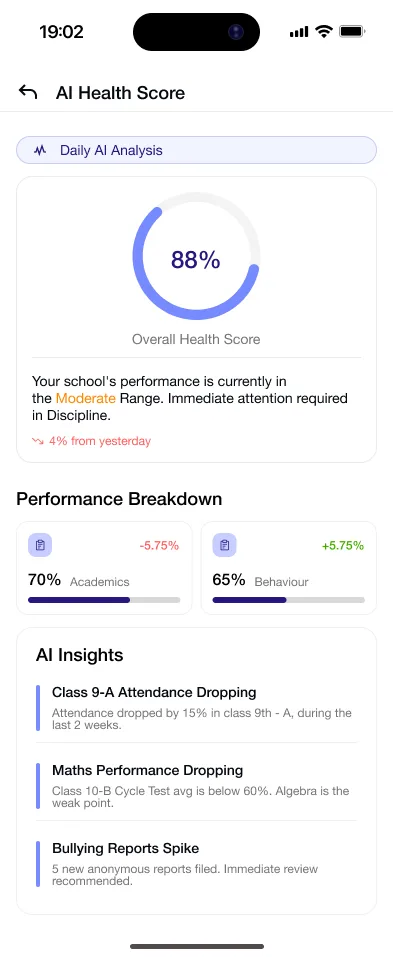
Health scores in the real app: every student, every class, scored daily.
Common questions
What is at-risk student detection?
At-risk student detection is an early-warning system that identifies students who are starting to struggle, before it shows up as a failed exam or a dropout risk. It works by monitoring attendance and academic trends per student and flagging meaningful declines to teachers and school leadership early enough to intervene.
How does Gyanama detect at-risk students?
Gyanama’s Brain analyses each student’s attendance and marks against their own history and their class. When the pattern turns, repeated absences, a slide across subjects, a drop below the student’s usual level, it raises a flag with the evidence attached. Detection runs on the school’s live data automatically.
What do teachers see when a student is flagged?
The flag, the reason and the trend: which signals moved, since when, and how far. A class teacher sees their own students; the principal sees the school-wide picture in daily health scores. From there the school decides the human response, a conversation, a parent call, extra attention.
Why do schools miss struggling students without this?
Because each signal lives in a different place. The attendance register shows absences, mark sheets show one exam at a time, and no one has time to cross-reference 40 students weekly. The pattern only becomes obvious at the report card, months after it started. Software that reads everything together catches it in week two, not month three.
